MCAS vs Histamine Intolerance: How to Know Which One You’re Dealing With
You eat a meal and your face flushes. Your heart starts pounding for no reason. You break out in hives after a hot shower, get a migraine when the weather shifts, or feel wired and anxious at 2 a.m. even though you did everything “right.” MCAS vs. histamine intolerance can be confusing because the two conditions often share similar symptoms, including digestive issues, headaches, flushing, and reactions to certain foods.
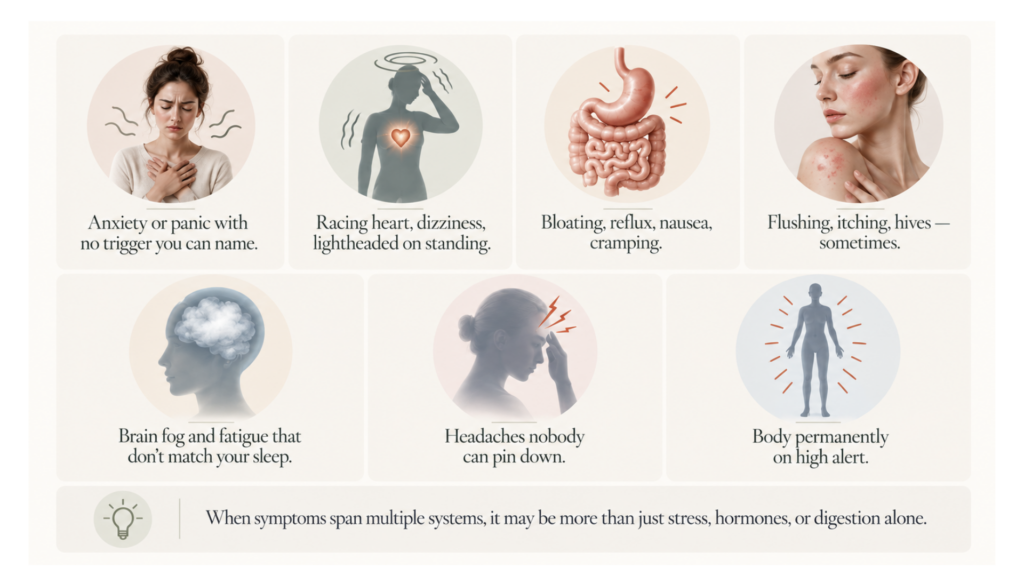
You’ve probably seen a handful of doctors. Your labs come back “normal.” Maybe someone told you it’s stress, or anxiety, or that you just need to relax.
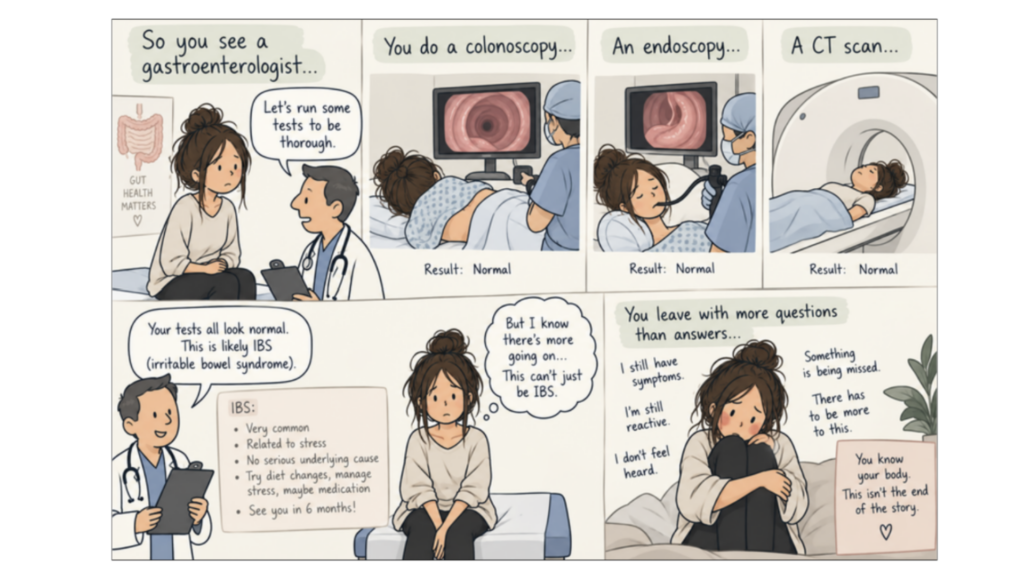
Then you stumbled onto the words histamine intolerance. Or mast cell activation syndrome. And something clicked.
If that’s you, this post is for you. And if you already know you’re dealing with one of these, stick around, because the difference between the two changes what actually works. A lot of people get stuck for years because they’re treating the wrong one.
First, What Histamine Actually Does
Histamine isn’t the enemy. It’s a chemical messenger your body uses every day. It helps you digest food, regulates stomach acid, supports your wake cycle, and helps your immune system respond to threats.
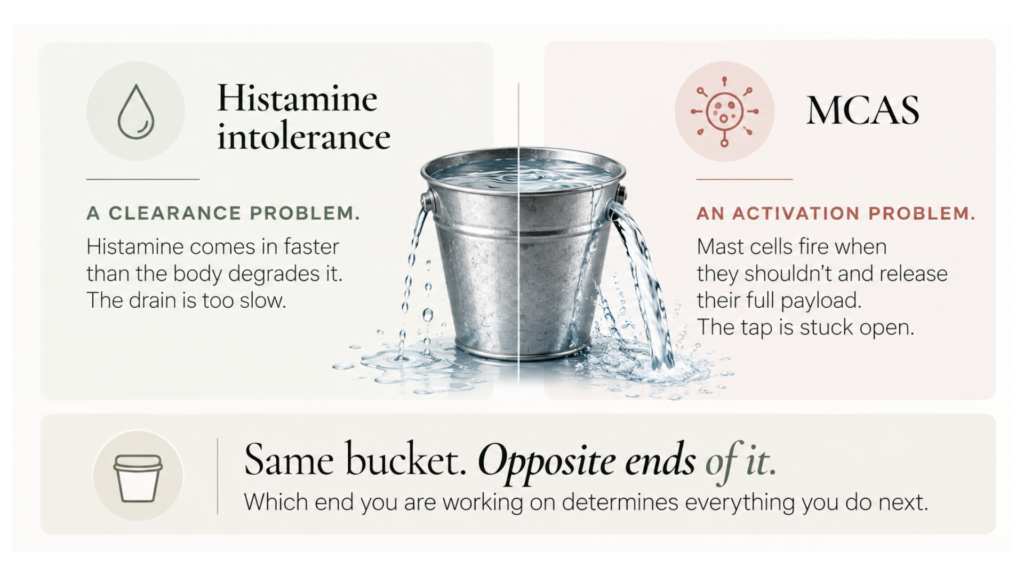
Problems start when your system has more histamine than it can clear. I like to think about it as a histamine bucket.
Everything that adds histamine pours into the bucket: food, stress, poor sleep, gut infections, hormones, mold, and chemical exposures. Your body is constantly draining the bucket through enzymes that break histamine down. When the bucket overflows, you get symptoms.
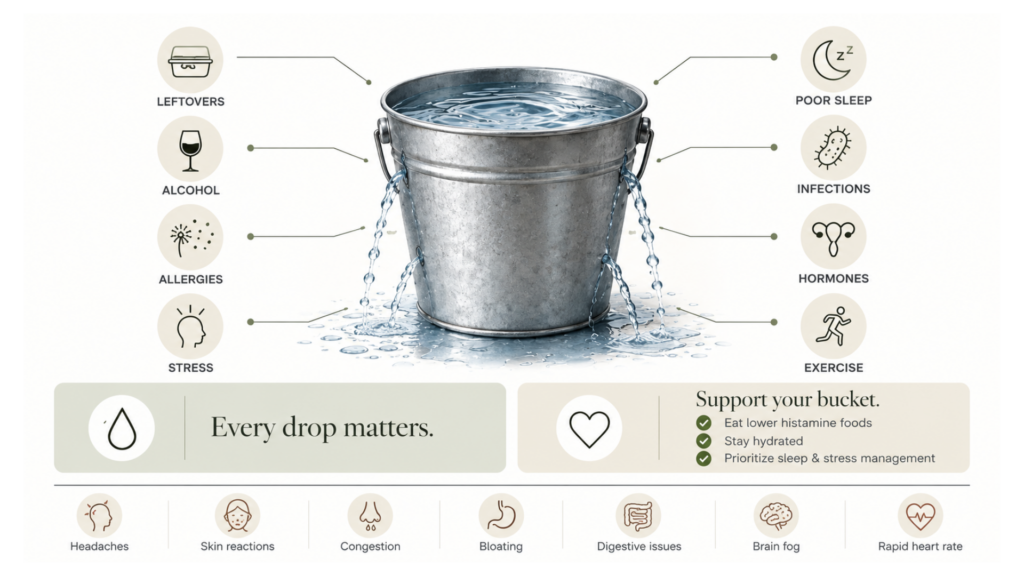
Here’s the key: histamine intolerance and MCAS both overflow the bucket, but for very different reasons.
What Is Histamine Intolerance?
Histamine intolerance is a breakdown problem. Your drain is clogged.
The main enzyme that breaks down histamine from food is called DAO (diamine oxidase), and it’s made mostly in your gut lining. If DAO is low or blocked, histamine from the food you eat builds up faster than you can clear it.
Things that commonly lower DAO or slow histamine clearance include:
- Gut inflammation, leaky gut, or damage to the intestinal lining
- Dysbiosis, especially an overgrowth of histamine-producing bacteria
- SIBO
- Certain medications and alcohol
- Nutrient gaps that your breakdown enzymes depend on
- Genetic variations in how you make DAO
Histamine intolerance symptoms often show up after eating and include flushing, itching, headaches, a stuffy or runny nose, bloating, diarrhea or constipation, a racing heart, and fatigue.
The big clue: symptoms tend to track closely with what you eat. Leftovers, aged cheese, wine, cured meats, fermented foods, and tomatoes are classic triggers. And importantly, histamine is heat stable, so reheating leftovers doesn’t reduce it. The longer food sits, the more histamine it builds.
What is MCAS?
Mast cell activation syndrome is a release problem. Your faucet is stuck on.
Mast cells are immune cells that live in your tissues, especially where your body meets the outside world: your skin, gut, airways, blood vessels, and nervous system. They’re your first line of defense. When they sense a threat, they release chemical messengers called mediators.
In MCAS, mast cells become overreactive. They fire at things they shouldn’t and don’t calm back down afterward.
And this is the part most people miss: histamine is just one of the mediators mast cells release. Researchers have identified more than 1,200. That includes tryptase, prostaglandins, leukotrienes, and inflammatory cytokines. So you can go completely low histamine and still feel terrible, because histamine was never the whole story.
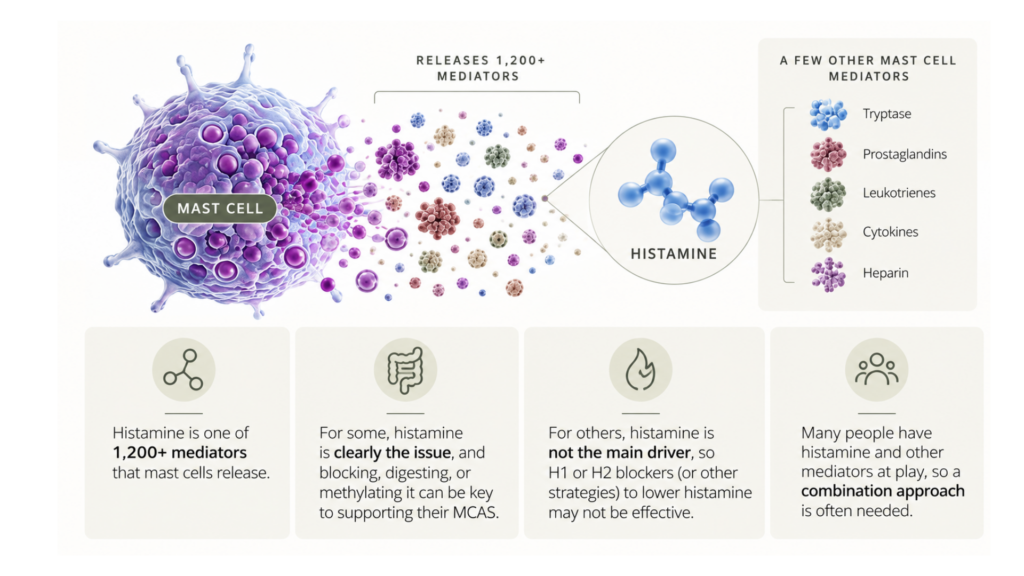
Because mast cells live everywhere, MCAS affects multiple systems at once. Symptoms can include:
- Skin: flushing, hives, itching, rashes, dermatographism (a red raised line when you scratch your skin)
- Gut: bloating, reflux, cramping, diarrhea, constipation, nausea, food reactions that keep expanding
- Heart and circulation: racing heart, blood pressure swings, dizziness when standing, POTS
- Brain and nerves: anxiety that feels physical, brain fog, insomnia, headaches, migraines, tingling or burning
- Respiratory: congestion, throat tightness, wheezing, shortness of breath
- Musculoskeletal: bone, joint, and muscle pain
- Hormonal: heavy or painful periods, symptoms that spike around your cycle, pregnancy, or menopause
- Bladder: frequency, urgency, pain that looks like a UTI with no infection
If you’ve ever felt like you have 12 unrelated problems and no one can connect them, this is often why.
The Key Differences Side by Side
| Histamine Intolerance | MCAS | |
|---|---|---|
| Core problem |
Can’t break histamine down fast enough |
Mast cells release too many mediators |
| Mediators involved | Histamine, mostly from food | Histamine plus many others (tryptase, prostaglandins, leukotrienes) |
| Main triggers | High histamine foods, alcohol, gut issues | Food plus heat, cold, fragrance, stress, exercise, pressure changes, mold, meds, supplements |
| Timing | Usually tied to meals | Can be immediate or delayed up to 2 to 3 days |
| Body systems | Often gut, skin, head | Two or more systems, often many |
| Low histamine diet | Often brings real relief | Helps partially, or not at all |
| Severity | Uncomfortable, disruptive | Ranges from mild to debilitating, can include anaphylaxis-like episodes |
7 Questions to Help You Figure Out Which One Fits
Ask yourself these honestly:
1. Do your symptoms mostly show up after eating?
If yes, and they settle when you eat fresh, low-histamine meals, that leans toward histamine intolerance.
2. Do you react to things that aren’t food?
Perfume, cleaning products, hot showers, temperature swings, storms, stress, exercise, vibration, tight clothing. Non-food triggers point strongly toward mast cells.
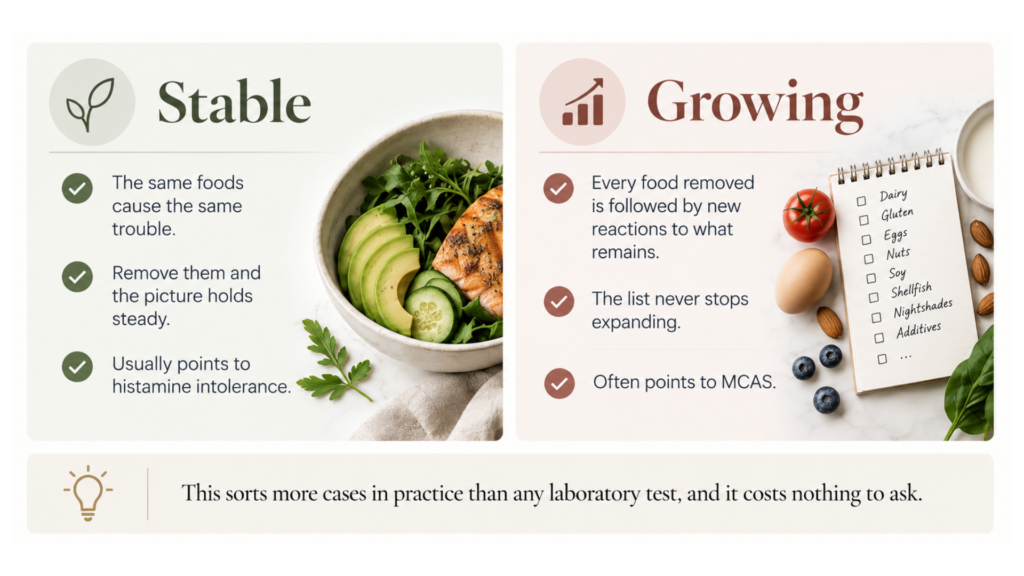
3. Did a low histamine diet help, but only partway?
If you’ve cut everything and you’re still flushing, anxious, or reacting, you’re likely dealing with more than histamine alone.
4. Is your list of safe foods shrinking?
Reactions that keep expanding to new foods, supplements, and medications are a classic MCAS pattern.
5. Do you react to medications or supplements, even ones that “shouldn’t” cause problems?
Many people with MCAS react to fillers, dyes, and preservatives in pills, not the active ingredient itself.
6. Are multiple body systems involved?
Gut plus skin plus heart rate plus brain fog plus joint pain is a very different picture than bloating and headaches after wine.
7. Did it start or get worse after a big event?
A viral infection (including COVID), mold exposure, surgery, an implant, a period of intense stress, pregnancy, or menopause. These are common turning points for mast cells.
5. Do you react to medications or supplements, even ones that “shouldn’t” cause problems?
Many people with MCAS react to fillers, dyes, and preservatives in pills, not the active ingredient itself.
6. Are multiple body systems involved?
Gut plus skin plus heart rate plus brain fog plus joint pain is a very different picture than bloating and headaches after wine.
7. Did it start or get worse after a big event?
A viral infection (including COVID), mold exposure, surgery, an implant, a period of intense stress, pregnancy, or menopause. These are common turning points for mast cells.
If you answered mostly yes to questions 1 and 3 but no to the rest, histamine intolerance is likely a big piece of your picture.
If you said yes to several of 2, 4, 5, 6, and 7, mast cells are worth looking into seriously.
Here’s the Part Nobody Tells You: It’s Often Both
MCAS and histamine intolerance aren’t always separate. They can feed each other.
When mast cells are dumping histamine all day, your breakdown enzymes get overwhelmed. At the same time, gut inflammation from mast cell activity can lower DAO production. So many people have a faucet running on high and a clogged drain.
That’s why guessing and restricting on your own so often backfires. You can shrink your diet down to six foods and still be flaring, because you’re only working on one side of the bucket.
How MCAS and Histamine Intolerance Are Tested
There’s no single perfect test for either, which is part of why so many people go undiagnosed.
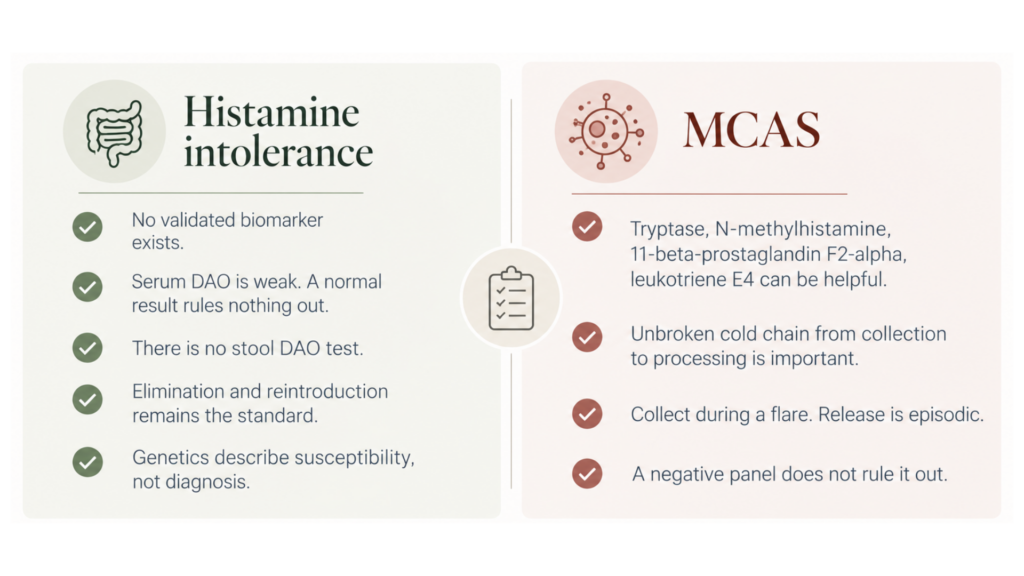
For histamine intolerance, providers may look at blood DAO levels, symptom response to a structured low histamine trial, and gut markers that point to why DAO might be low.
For MCAS, diagnosis generally involves a combination of:
- A thorough symptom history across multiple body systems
- Physical signs like dermatographism or orthostatic changes in heart rate and blood pressure
- Blood and urine tests for mast cell mediators like tryptase, N-methylhistamine, prostaglandin D2 metabolites, and leukotriene E4
- Sometimes special staining of existing GI biopsies to count mast cells
One frustrating reality: these mediators break down fast. Samples have to stay chilled and be handled the entire way correctly, and many labs don’t do that well. A negative result doesn’t always mean you don’t have it.
Functional testing like comprehensive stool analysis can also add important context, showing things like histamine-producing bacteria, low butyrate, gut inflammation, parasites, or a leaky gut barrier that may be adding to your bucket.
What Actually Helps (And Why Order Matters)
Whether you’re dealing with histamine intolerance, MCAS, or both, the approach I teach follows the same sequence. Order matters, especially if you’re sensitive and tend to react to everything you try.
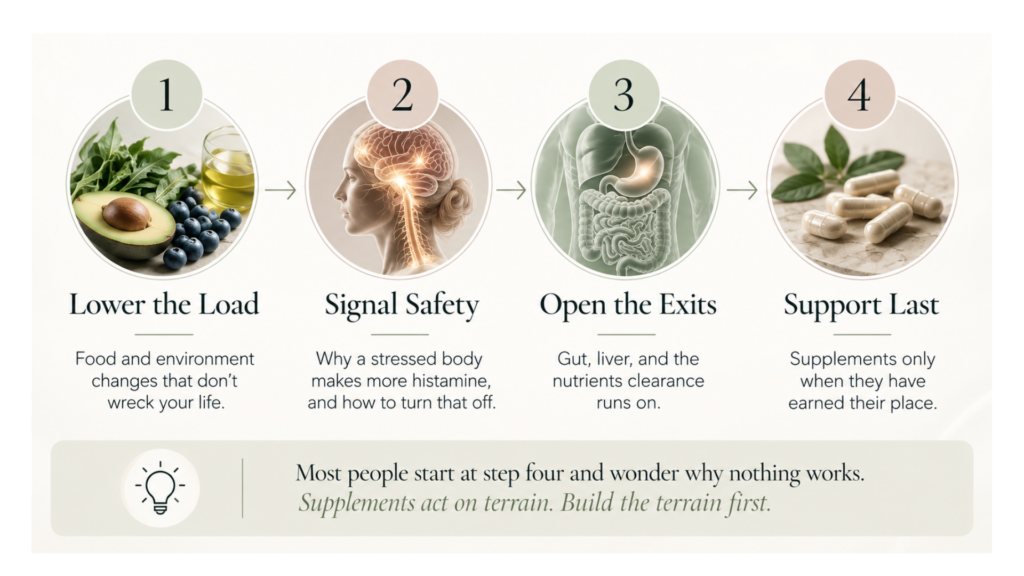
1. Lower the load.
Figure out what’s pouring into your bucket and turn it down. That includes food triggers, but also mold, fragrance, chemical exposures, sleep loss, and gut issues like constipation, which recycles histamine and toxins back into your system.
2. Signal safety.
Calming your nervous system comes next. Mast cells and your nervous system talk constantly. A body stuck in fight or flight keeps mast cells on high alert. Nervous system regulation, consistent light and dark cycles, and genuine rest aren’t “extras.” For many people, this is where things finally start to shift.
3. Open the exits.
Lowering the load only gets you so far if nothing is leaving. Heal the gut lining, address dysbiosis and infections when your body is ready, support liver and bile flow, and give your histamine-clearing enzymes what they need to work.
4. Support last.
Supplements only once they have earned their place. This is the step most people jump to first, and it’s why so many of them feel worse. If you’re reactive, adding five new supplements at once is a recipe for a flare. Once the foundation is stable, targeted support can be layered in one at a time, often starting at tiny doses, ideally with a practitioner who understands mast cells.
If you’re sensitive, slow is fast. The goal isn’t to push your body. It’s to help it feel safe enough to stop reacting.
If You Already Know You Have MCAS or Histamine Intolerance
You might be reading this thinking, “I’ve done the diet. I’ve tried the antihistamines. I’m still not better.”
That doesn’t mean you’re broken or that nothing will work. It usually means one of these is true:
- You’re treating histamine when other mediators are driving your symptoms
- Something is still filling your bucket that hasn’t been identified (mold, a gut infection, a hidden exposure, hormones)
- Things were introduced too fast or in the wrong order
- Your nervous system is still stuck in threat mode
MCAS in particular is something you learn to manage over time. It’s rarely a quick fix. But people absolutely get their lives back, often in ways that surprise them, when they work on the right layers in the right order.
Want to Go Deeper?
I put together a free masterclass that walks through all of this: the histamine bucket, how to map your symptoms, which tests are actually worth it, and the exact order I use to help reactive clients calm things down without making them worse.
Watch the Free MCAS and Histamine Masterclass

Frequently Asked Questions
Can you have MCAS and histamine intolerance at the same time?
Yes. They often overlap. Mast cells releasing excess histamine can overwhelm your breakdown enzymes, and gut inflammation from mast cell activity can lower DAO.
Why is my low histamine diet not working?
If your symptoms don’t fully improve on a low histamine diet, histamine may not be the only issue. MCAS involves many mediators beyond histamine, and non-food triggers like stress, mold, and chemicals can keep your bucket full.
Is MCAS common?
It’s more common than most people realize. Some research out of Germany has estimated it may affect as much as around 17 percent of the population, with a wide range of severity. Many people have mild versions they manage without ever getting a name for it.
Can histamine intolerance cause anxiety?
Yes. Histamine acts as a neurotransmitter in the brain, and excess histamine can contribute to anxiety, racing thoughts, insomnia, and a wired but tired feeling.
Do antihistamines help with MCAS?
They help some people and not others. If you feel better on them, that’s supportive of mast cell involvement. If they don’t help, it doesn’t rule MCAS out, because other mediators may be driving your symptoms.
How long does it take to heal from MCAS?
It varies. Some people feel meaningful change within weeks, and others need months. Most people with MCAS manage it long term rather than “curing” it, but quality of life can improve dramatically.
You’re Not Reacting to Everything. You’re Living at the Top of Your Bucket.
If you’ve read this far, you probably saw yourself somewhere in this post. Maybe it’s the flushing after dinner, the 3 a.m. wake-ups, or the list of safe foods that keeps getting shorter.
You don’t need another elimination diet or another bottle of supplements. You need to know which problem you’re actually solving, and the right order to solve it in.
In my free MCAS and Histamine Masterclass replay, I’ll walk you through:
- How to tell if you have a clearance problem, an activation problem, or both
- The hidden things filling your bucket that most people never get tested for
- Which tests are actually worth your money, and why a negative result doesn’t mean you’re fine
- The 4-step order I use with my most reactive clients to calm things down without triggering a flare
And if you’re ready for one-on-one support now, book a call with my team. We’ll look at your story, figure out what’s filling your bucket, and map out the right order for you.
You’ve spent long enough hearing that your labs look normal. Let’s find out what’s really going on.
This article is for educational purposes only and is not medical advice. Please work with a qualified healthcare provider for diagnosis and treatment.

Rachel Scheer is a board-certified functional nutrition practitioner with a BS in Nutrition Science and Dietetics from Baylor University and the founder of Rachel Scheer Nutrition. After healing her own severe gut dysfunction, she built a practice that has helped thousands of clients address the root cause of chronic illness.
Read This Next
You eat a meal and your face flushes. Your heart starts pounding for no reason.…
If you’re wondering why SIBO keeps coming back even after antibiotics, antimicrobials, or a restrictive…
The gut skin connection plays a major role in acne, inflammation, hormone balance, digestion, and…